
METACOGNISANCE
I developed metacognisance as an approach which effectively combines the techniques of traditional counselling (talking therapy), modern coaching methods and somatic therapy. This approach is designed to meet the complexities of our rapidly evolving technological society, newly-developing psychological and emotional landscapes and diverse relationship needs. It is born from both a professional and personal path of self-discovery, awareness and individuation based on over 25 years experience and is a unique blend of counselling (CBT), somatic experiencing, mindfulness, inner-child healing, shadow integration work, journey therapy, internal family systems (IFS), holistic life coaching and mind-body healing.
M
The term metacognisance
encompasses an in-depth, innovative, and holistic approach to mental, emotional, physical, (and metaphysical) wellbeing and it is my sincere wish that others may use and apply this approach, as a psychological, educational or personal tool, in order to better come to know themselves, their authentic nature, potential and life purpose.
I combine my wealth of experience in one-to-one therapy with a passion for exploring and understanding the human condition to assist and facilitate others to release themselves from limiting thought processes, conditioned beliefs, programs, traumatic memories and emotions which keep them trapped in identities, roles, jobs, relationships and lives which no longer bring satisfaction, meaning or joy.
Tracy James
BENEFITS
Everyone can benefit from this work, those who are debilitated by intrusive thoughts, negative emotional states and recurring issues or those who simply find it difficult to identify and express emotions, often repressing or acting out their pain in the process. It
is designed to remove the discomfort, irrational fear and judgment that many attach to their emotions.
By more fully understanding how acquired conditioning filters and distorts thinking and feeling, in terms of fear, bias and confusion, we can free ourselves from its effects. This conditioning includes the beliefs and mind-sets accepted and absorbed from families, peers, society, media, culture and religion/spirituality.
The process focuses on how to think more clearly, not on what to think. By observing, identifying and dismantling limiting or detrimental thoughts and emotional reactions, more refined thinking naturally emerges.
It is not about idealism, obsessive goal-setting and quick fixes, nor framed in provisional or destination thinking, i.e.when I do, get, reach..
Rather it is essentially a long-term and long-lasting approach which requires patience, understanding and a willingness to self-reflect in order to fully grasp and implement. It is not based on you doing or becoming, so much as removing that which prevents you from fully being.
RESULTS
Develop more awareness, comprehension and clarity on what, why and how you think.
Cultivate more self-awareness and self-acceptance, which greatly reduces perfectionist tendencies both personally and professionally and in turn eliminates states of guilt or shame.
Become comfortable in your own skin and align with more authentic and appropriate life goals.
Communicate and interact with presence, through speaking your truth and actively listening to others.
Increase creativity and productivity in everyday life as you free up more psychological space.
Generate emotional intelligence which aids expression, processing and reduces the potential for damaging emotional reactions leading to healthier emotional responses.
Understand and assimilate 'triggers' -essentially the wounds and scars which shape life experience- so that you can fully heal and not be at the mercy of those stored memories in the present.
Develop appreciation of your own and others' attachment and communication styles in order to relate in healthier ways to partners, friends and colleagues.
Empower yourself to improve or change your life circumstances by taking responsibility and refusing to project blame onto any external party.
Strive for self-actualisation and learn how to rely on clear, internal guidance rather than blindly following external opinions or falling prey to projected criticism, judgment and manipulation.
Override embedded neural patterns and release historic or unwanted emotions, identifying unhealthy behavioural tendencies to better navigate previously challenging situations and relationships.
One-to-one sessions
Personal, tailored approach
Unique Approach
Online sessions and webinars
Thinking and feeling more clearly, shapes and reforms all aspects of life
After we help you uncover the programs holding you back,
we'll work together to release them.
EMOTIONS
Emotional intelligence
Learn how to:
-constructively express and manage the full spectrum of emotions.
-override the impulse to avoid, ignore and repress emotions.
-develop healthier emotional responses as opposed to reactions.
-tell the difference between instinct, socially constructed emotions and automatic emotional reactions.
-create strategies for emotional resilience and reduce the tendency to take others' emotional reactivity personally.
-eliminate the need to project or attach blame onto others.
-navigate difficult and chronic emotional states for more effective long-term mood management.
-become more aware of emotional bias and how it impacts rational reasoning.
-recognise the influence of thoughts on the creation and continuance of emotional states, eg guilt, shame, regret and resentment.
Emotional Processing & parts work
Many of us have learnt to suppress emotions which were not encouraged or allowed in early upbringing and environments, or through trauma shutdown.
In some cases these natural human responses are often judged as wrong, bad or negative and over time we may learn to ignore, hide or numb them.
Psychologically, this suppression may lead to the development of subpersonalities or personas, parts of ourselves we create to ‘protect’ the pain or shame, so we may then have difficulty actually identifying with our authentic selves.
This sense of vulnerability can also be covered up through excessive thinking and rumination or physically through
medication and addiction, quick-fix methods to numb the pain, which can lead to even more problems and pain.
The emotional release work , understanding and integrating fragmented parts of our psyche really allows these thoughts, feelings and complexes to be fully processed and addictive habits to be understood compassionately as a way of trying to meet fundamental human survival needs.
This emotional intelligence is vital within our larger social structures too, in a world where the focal emphasis is on power, money and competition, the results often point to a rise in separation, stress and isolation. Seeking success, in an external sense, can ultimately be unfulfilling if we overly identify with our projects, image and status at the expense of our innermost needs.
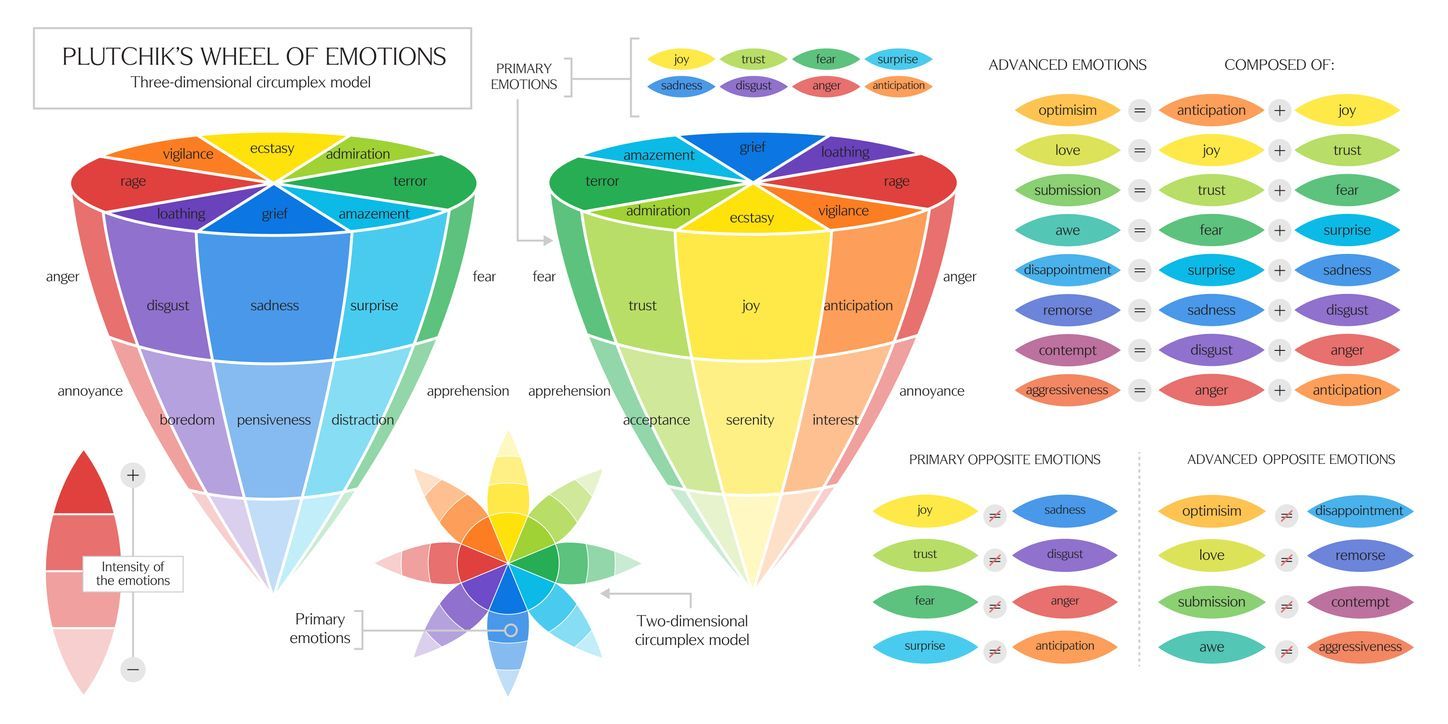
The holistic model
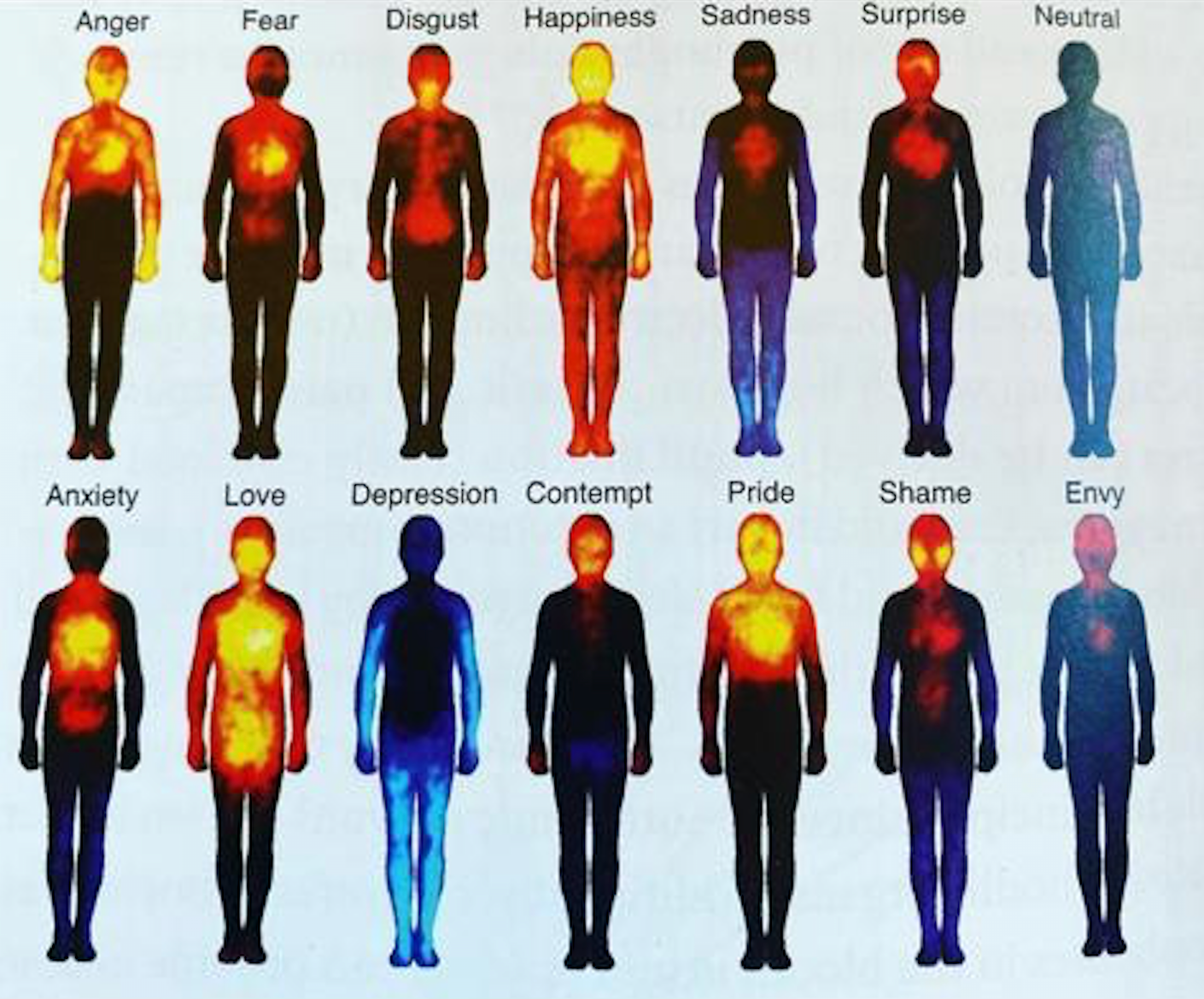
Mind, body and emotion are never really separate as the autonomic nervous system acts as a network of communication between all three. The heat map below charts the activation of bodily sensations associated with different emotions using a unique self-report method
(2013 Neuroscience study, Nummenmaa, Glerean & Hari)
These states are relatively hardwired to include emotions and bodily responses, variation only occurs in how they are expressed or verbalised.
Unfortunately these emotions don’t just disappear, instead they can become lodged or 'stuck' in the body, evidenced more and more in mind-body medicine to potentially lead to much greater damage, including development of complexes, neuroses, exhaustion and chronic health issues.
Somatic processing
Through focussing on internal physical sensations (interoception) it will become clearer as to how trauma is stored in the body. Techniques such as 'bottom up' type processing allow you to feel,
breath through and release unwanted emotional pain and deepen into a state of physical relaxation to more effectively regulate the parasympathetic nervous system.
Exploring and connecting to emotions as physical phenomena within the body free from fear of judgment, criticism, punishment or rejection improves confidence in understanding and coping with them. Releasing difficult or intense emotions is usually the clearest indication of where change is most needed and often uncovers the root of longstanding issues.
The origin of thought patterns and belief structures keeping you stuck in depression or other chronic states of fatigue and anxiety can also be uncovered and removed through these practices. Identifying triggers and patterns of acute emotion and differentiating these from moods which reflect chronic or longer term emotional states, usually based on a set and repetitive narrative, is vital to prevent development of further issues.
('Top-down' techniques are incorporated at this point, eg CBT, coaching to uncover thought and belief patterns-challenge and remove.)
Using a balanced approach is beneficial as it covers all aspects of the person ensuring health and well-being, physically, mentally and emotionally.
THOUGHTS
Consider thoughts as essentially physical phenomena, happening in the brain in an electrical and chemical form, repeated so they become core beliefs, stored and shaped in the form of memories.
BENEFITS OF UNDERSTANDING YOUR THOUGHTS (origins,programs and patterns )
- Observing your cognitive processes objectively leads to a greater ability to inquire and reason without the impulse to form opinions, illusions and delusions.
- Disentangling beliefs and concepts from self-image and identity leads to greater peace of mind and constructive change in behaviour and life circumstances.
- This in turn reduces compulsive tendencies to control, judge, attack, defend, compare and compete.
- Understanding how fear moulds beliefs allows us to challenge and remove associated false hopes and expectations which often lead to disappointment or resentment.
- Interacting with others as they are, increasing empathy, listening without bias or pre-judgment enables more rational, reasonable thinking and harmonious connections.
BELIEFS
Metacognisance assists in creating distance and objectivity over thought forms and belief systems so that they can be clearly identified, observed and understood.
In this way clarity and control is gained over intrusive, unwanted, limiting and outworn thoughts, allowing for clearer thinking to develop.
Beliefs can be considered as illusory constructs of the mind, programmed in the brain’s neural pathways, replicated and repeated as patterns which in time and with practice can be questioned, challenged and deconstructed.
While some beliefs contribute constructively to forging bonds and sustaining communities, in terms of habits and traditions, many do exactly the opposite.
A belief is an idea, not reality or a person, group or race, formed as a means of creating apparent certainty, understanding and explanation of our existence, mainly through fear of uncertainty or not knowing!
They bear little resemblance or relation to 'what is' in actuality.
Through questioning beliefs, the likelihood and problem of cognitive dissonance is also greatly reduced - ie.,opposing beliefs, behaviour or character traits.
CONCEPTS
Metacognisance takes us through a vital process of understanding our relationship with concepts and how we may mistakenly have based our experience of reality on them.
As we shed new light on these symbolic notions and really come to understand their innate limitations, we can live through more direct and fulfilling experience. Some of the concepts considered include:
· Perfectionism
· Freedom
· Desire
· Identity
· Self
· Tribe
· God
If we can free ourselves from the weight and meaning of these concepts, our experience of life emerges through greater observation, clarity and presence. This enhances inner fulfilment, relationships with others and vastly improves judgment faculties and decision-making abilities.
KNOWLEDGE
Knowledge and learning are two different things. Thinking and thought are two different things.
It is, of course necessary to give knowledge its place as a factual, informative and
essential component of human development. Yet to employ it as a cognitive function only
clouds our judgment and decision-making faculties with rigidity, opinion and bias.
Before just accepting what we see, read and hear, can we take that essential pause to
think? ie, learn through observing and interacting with our natural environment and the people in it,
and to notice how our brains interact with the information presented.
Can we actually relate to, process and observe without the tendency to judge, define, confirm or deny, based on what we already know?
Clear thinking requires the dismantling of all we know and think we know, only then we can become more aware of how we are receiving and interfacing with the information fed to us constantly.
This in turn can eliminate fear or resistance to learning from another perspective and in an original way.
UNCOVERING BELIEFS
Beliefs are not always clear or conscious so a willingness to delve deeper and self-reflect is needed, this will give you a clearer indication of the root causes of imbalance in your life in general.
AUTOMATIC NEGATIVE THOUGHTS (ANTS)
These can describe a wide range of ways and types of thinking from provisional/conditional, all or nothing, catastrophising, labelling, mind-reading, comparing, guilt-inducing, blaming to projecting unknown futures and expecting pessimistic outcomes.
MINDSET IS KEY
A fixed mindset is the belief that your intelligence, abilities or traits are already set.
A growth mindset is understanding that your mind is adaptive and always capable of more learning and development.
Identify the limiting belief(s) and ANTs
Note related actions
Consider what you actually do or avoid based on these beliefs and narratives.
Become more aware of how they influence and shape your everyday habits, relationships and lifestyle choices.
Notice emotion & interpreted feelings
Process in the body
Feel how you physically experience emotional shifts and moods activated through cognitive processes, neurons, hormones and chemicals.
Question and challenge
Find the origin and truth of the belief or ANT
Ask how accurate, relevant or true this thought/belief is in your life right now.
Ask where/from whom this thought originated.
Keep in mind that thoughts are just thoughts, they are not always truth or fact.
Take action
Reframe and repeat
Train your mind to frame thoughts from a more positive perspective.
Ensure to make this dismantling/removing a daily or regular habit.
SELF - PERSONA & SHADOW
'Self' may be understood as a construct or image, created in early and formative years as a means to gain approval, a sense of belonging and apparent safety.
The self can be viewed as the result of all the subjective memories, experiences and messages received throughout life. It therefore inevitably interferes with our current capacity to think clearly about situations and relationships.
Even though this persona may now limit, damage, deceive us, or outgrow its use, we often cling to its familiarity and falseness, in fear of not knowing who we are without it.
Metacognisance assists in releasing the need for and attachment to a self-image, persona or particular identity, in turn freeing us from the need for external validation, including praise and criticism.
Work on the self opens up profound and powerful insights, which can lead to breakthroughs in people-pleasing habits, perfectionism and ‘imposter syndrome.'
Over time the limited image of self/persona begins to fade, giving way to a deeper sense of inner fulfilment and peace.
The process of metacognisance challenges us to meditate beyond this image and access a more expansive understanding of ourselves, one in continuous connection and communication with others and the natural world.
In this vibrationally higher state of consciousness we can become more aware of our deeper needs and purpose, one not limited to a superficially constructed identity.
SHADOW
The psychological term 'shadow' refers to the unconscious aspects of ourselves, both negative and positive, which we have hidden or repressed through fear of judgment, shame or punishment.
Not recognising, acknowledging or integrating these elements can lead to conflict, confusion and distress internally and in relationships with others.
Often what we dislike or disown in ourselves may be projected as criticism, judgment or envy onto others.
Shadow work requires introspection and an honest assessment of values in order to take responsibility for ourselves and our life circumstances.
It is an essential step in developing self-acceptance and becoming a more authentic presence in the world.

INNER CHILD
Inner child work is a well-established psychological model which involves reconnecting with parts of yourself that may not have received the compassion and attention needed during childhood.
Relationships with early caregivers can have a lasting psychological and emotional imprint and influence how we care for ourselves as adults.
If they remain suppressed or unintegrated, these childlike aspects of your personality can emerge, frequently during stressful or challenging periods of life and create issues and conflict.
A powerful part of this process involves visualising how you would parent those forgotten parts of yourself today whilst remaining curious and open to fresh perspectives and approaches. As you give more care and compassion to those parts, you can begin to heal some of what may have been missing in your childhood.
It is important to note that this process focuses on re-integration, not on apportioning or dwelling on blame of caregivers or past circumstances.
In this sense it serves to heal, extending compassion to any trauma memories of yourself in childhood and to the past environment and circumstances.
Inner child work has proven to contribute significantly to breakthroughs and turning points in better understanding who you are and how to take better care of yourself.
Healing these childhood wounds and traumas allows you to meet emotional challenges as an adult with more strength and resilience.
Relationships
Relationship - a connection between individuals,
which allows each one to understand themselves more clearly.
RELATING
The approach focuses on breaking down programmed and limiting definitions of relationships, shifting attention instead onto how we are ‘relating.’
- Generate a clearer understanding of beliefs and programs around love, romance and sex.
- Identify programs based on fear of lack, loneliness or desire enabling ways to find inner value, acceptance and wholeness first.
- Get clear on the reasons and people you desire or attract and uncover the underlying/unseen reasons for the making and breaking of romantic bonds.
- Recognise and release outworn and unhealthy attachments to self-image, ex-partners and memories.
- Consider how current modes of interaction and communication in friendships and intimate relationships are shaped by early familial and social bonds and how they reflect the patterns, styles, strengths and weaknesses contained within those.
- Develop more empathy, shift from self-absorption into active observing, listening and understanding of others to foster more meaningful connections.
- Let go of patterns of personalising others' words and actions and projecting thoughts and feelings onto others.
- Reduce the dependency and expectation on others to provide or make you happy, fulfilled or whole.
- Create better friendships and intimate relationships, more fully, consciously enjoyed, relating to others as they are, not as you imagine or wish they would be.
- Attract others based on compatibility, and how they enhance your life or support your growth.
MIRRORING
As humans are social creatures by nature, our connections with family, friends, partners and strangers are not only a necessary means of survival, they also allow us to grow and work on the aspects we value, like or dislike in ourselves as they are reflected or highlighted through these interactions.
(Mirror neuron research and development is now bringing a clearer understanding of how this reflection operates, eg in how humans empathise with each other)
We can choose to fear, avoid, deny or reject these aspects of ourselves, or accept them as a means to grow, to understand who and what we are more clearly, and to deepen our connections in the process.
Metacognisance reframes limiting and outdated expectations of relationships and marriage into a more holistic view, challenging why we may even think that we need another person to feel whole in the first place. Understanding diverse attachment styles can also assist in dealing with differences and obstacles but only in order to ultimately break down any unhelpful labels or limitations.
Exploring fresh perspectives on love and affection, including how we actually love the version of ourselves as expressed when with a person, not necessarily the person themselves, assists in breaking patterns of idealising or obsessing over romantic interests and in reducing issues of possession, jealousy and other insecurities within relationships.
Partnerships based on similar levels of awareness, values and relatively equal energy exchange, physically, emotionally and psychologically have been shown to to be more stable and last longer even if life paths/styles, everyday choices and preferences differ.
Observing the mutual benefits and sacrifices created and modelled in our early familial and social connections, understanding
how these ties are moulded by and based on unspoken terms of value and exchange, allows each individual to neutrally assess their relationships and make more constructive decisions based on their current needs.
Less dependent, toxic, demanding and resentful relations arise giving way to healthier bonds, enhancing each person as an individual first. We may have to break down the conditioned and mostly unrealistic expectations we place on each other as rescuers, fixers, heroes and lovers.
This in turn reduces the common fears that prevent most people from leaving toxic or stale relationships, to be alone or to enter into new ones, from settling for what they know, even if it is unfulfilling, incompatible or abusive, to staying for financial reasons, convenience, misguided loyalty or obligation, children, approval, image or fear of being alone.
By working through issues individually, changes and choices can be made in committing or recommitting to relationships and friendships from a fresh perspective. Experience has shown this to be more effective than working on the relationship itself as it is this 'unit' which contains and perpetuates the problematic issues in the first place.
By targeting and breaking down the particular irrational fears keeping them trapped or confused, each partner can come to understand how and why communication, connection and intimacy operate as they do within their relationship unit.
The two most common fears of getting hurt and being rejected can also then be understood, processed and released.
As we eliminate the superficial reasons underlying relationship bonds, a new understanding develops and clearer choices can be made. This may allow ailing relationships to recover too as each person can commit through a genuine choice, so even bridges rebuilt can last. Fears and doubts
are taken into account and dealt with effectively, so each individual can be clear and honest about their real needs and reasons for staying in a relationship, or if need be, leaving to pursue their own happiness.
